 27 September, 2026
 Vidya
VidyaNCA Exam Time Management: How to Complete Your Exam Within the Time Limit
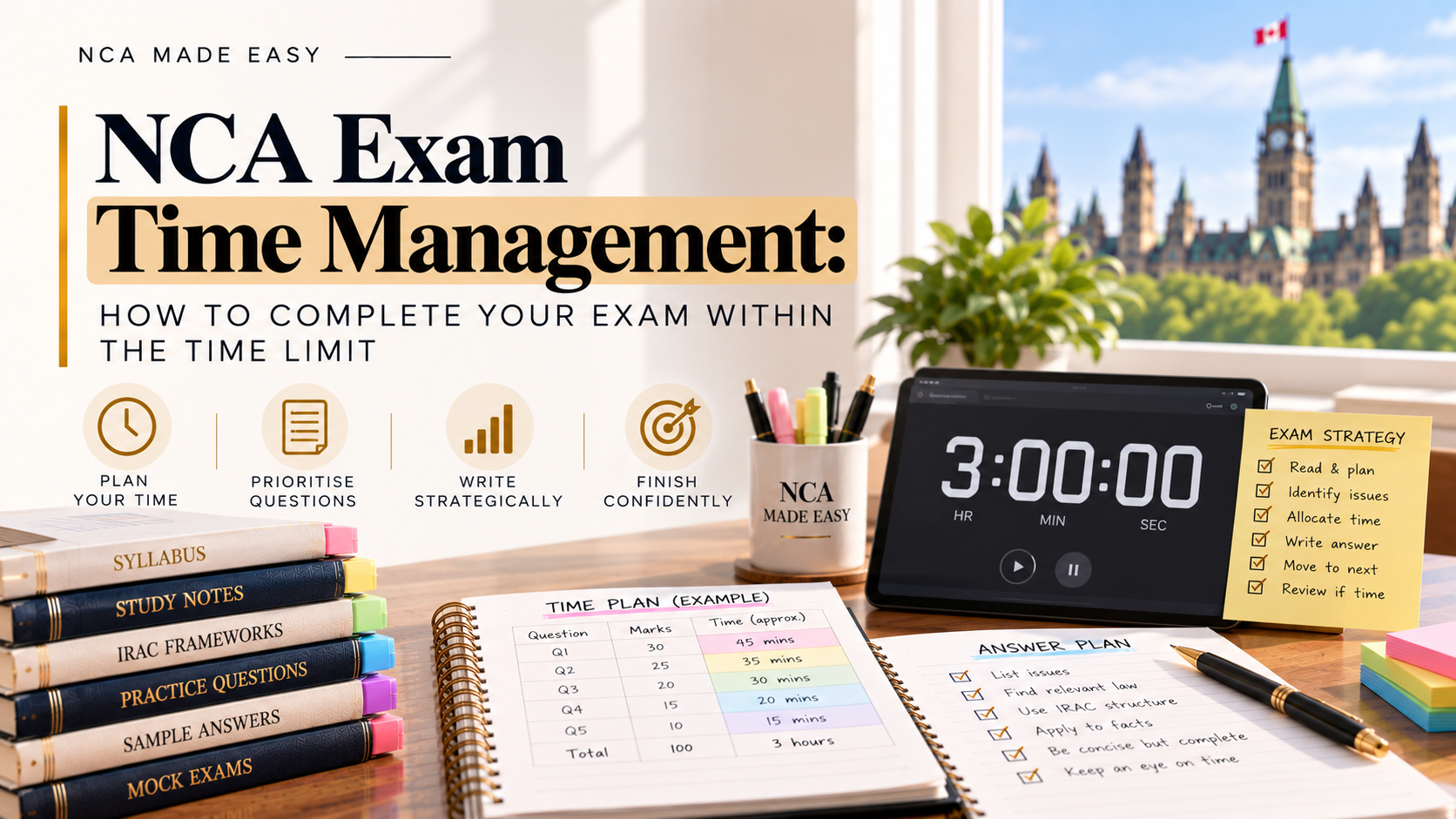
NCA Exam Time Management: How to Complete Your Exam Within the Time Limit
Knowing the law is essential for an NCA exam, but knowledge alone does not guarantee that you will complete the paper effectively.
You also need to decide how much time to spend reading, identifying issues, finding the relevant law, writing your answer and moving to the next question.
A candidate may understand the subject well and still struggle if too much time is spent on the first few questions. This is why time management should be practised throughout your NCA preparation—not only during the actual exam.
Here is a practical way to develop that skill.
1. Let the Marks Guide Your Time
One of the simplest principles of NCA exam time management is to allocate your available writing time according to the marks assigned to each question.
A higher-mark question generally deserves more time and analysis than a lower-mark question.
Before beginning the exam, look at:
* the total available time;
* the number of questions;
* the marks allocated to each question; and
* whether any questions contain several sub-parts.
Your objective is to avoid spending a disproportionate amount of time trying to perfect one answer while leaving insufficient time for the remaining questions.
2. Do Not Start Writing Immediately
When you see a lengthy fact pattern, it can be tempting to begin writing as soon as you recognise the first legal issue.
Instead, spend a short amount of time identifying the structure of the problem.
Ask yourself:
Who are the relevant parties?
What happened?
What legal issues arise?
Which rules, cases or statutory provisions may apply?
Are there arguments available to more than one side?
A brief answer plan can save time later because you are less likely to repeat yourself, overlook an issue or reorganise the answer halfway through.
3. Prepare a Quick Issue List
For a fact-pattern question, make a short issue list before drafting the complete response.
For example:
Issue 1 – Applicable rule – Important facts
Issue 2 – Applicable rule – Important facts
Issue 3 – Applicable rule – Important facts
You can then work through the issues systematically.
This is particularly helpful for integrated NCA questions where one factual scenario may engage several parts of the syllabus.
4. Keep Your Rule Section Proportionate
A common time-management problem is writing too much theory.
Your answer needs enough law to establish the applicable legal framework, but reproducing several paragraphs of notes before discussing the facts can consume valuable time.
State the relevant:
* legal rule or test;
* statutory provision, where applicable;
* leading authority; and
* necessary exception or qualification.
Then move into the application.
Your objective is not to demonstrate everything you know about the topic. Your objective is to answer the particular question you have been given.
5. Spend Enough Time on Application
Saving time should not mean reducing the analytical part of your answer.
Once you identify the applicable law, connect it directly to the facts.
Instead of simply stating that a legal test is satisfied, explain why the particular facts support or weaken each relevant element of that test.
Where appropriate, consider competing arguments.
This makes the answer more analytical without requiring unnecessary length.
A concise answer with strong factual application can be more effective than a lengthy answer dominated by general legal theory.
6. Know Where Everything Is in Your Materials
Time can also be lost searching repeatedly for cases, legislation or legal tests.
During preparation, organise your materials so that important information can be located quickly.
You may find it helpful to create:
* a table of contents;
* topic headings;
* case indexes;
* legislation indexes;
* IRAC frameworks;
* tabs or bookmarks; and
* clearly identifiable sections for important tests and exceptions.
Practise using the same materials while answering questions.
The goal is to reach a stage where you already know approximately where to look when a particular issue appears.
7. Do Not Get Stuck on One Difficult Issue
You may encounter a question where you are uncertain about the answer or cannot immediately locate the authority you need.
Do not allow one difficult issue to consume a disproportionate amount of the examination.
Identify what you can, apply the law you have located carefully, and keep track of your allocated time.
You can return to an answer later if time remains.
Protecting time for the rest of the paper is an important part of exam strategy.
8. Use a Time Checkpoint System
Do not wait until the final portion of the exam to check the clock.
Create checkpoints.
For example, after completing each major question, compare:
Where should I be according to my plan?
with
Where am I actually?
If you are falling behind, adjust immediately.
This is much easier than discovering near the end of the exam that a substantial question remains unanswered.
9. Practise Individual Questions Under Time Limits
Time management is a skill, and it improves through practice.
Once you understand the subject and have attempted some questions without strict timing, start setting time limits.
Your practice can progress gradually:
Stage 1: Answer questions without strict timing while learning the structure.
Stage 2: Complete individual questions within an allocated time.
Stage 3: Attempt several questions consecutively.
Stage 4: Complete a full mock exam under timed conditions.
This progression allows you to develop accuracy before adding examination pressure.
10. Track Why You Are Running Out of Time
If you repeatedly struggle to finish practice questions, identify the actual cause.
You may be:
* spending too long reading;
* searching through unorganised notes;
* writing excessive theory;
* overthinking the issue statement;
* discussing irrelevant law;
* failing to plan before writing;
* typing too slowly; or
* spending too long trying to perfect one answer.
Once you identify the problem, your practice becomes much more targeted.
For example, if locating authorities is consuming time, reorganise your notes.
If your answers contain too much theory, practise shorter rule sections and stronger application.
If issue spotting is slow, attempt more fact-pattern questions.
11. Use Mock Exams to Test Your Strategy
Mock exams should test more than your legal knowledge.
They should also test whether your entire examination method works under time pressure.
During a timed mock, assess:
* whether you completed every question;
* whether your time allocation reflected the marks;
* whether you identified the important issues quickly;
* how much time you spent searching your materials;
* whether your answers contained sufficient application; and
* where you began to fall behind.
After the mock, review both the quality of your answers and the way you used your time.
This gives you something concrete to improve before the actual examination.
12. Practise With the Materials You Intend to Use
Your study materials and your answer-writing strategy should work together.
If you have comprehensive notes but cannot find a legal test quickly, organisation needs improvement.
If you have IRAC frameworks but have never practised applying them to unfamiliar facts, they may not help as much as expected during the exam.
Use your notes, IRACs, case references and practice materials while completing timed questions so that navigating them becomes familiar.
How NCA MADE EASY Helps Students Prepare
At NCA MADE EASY, exam preparation focuses on both understanding the syllabus and learning how to use that knowledge effectively in an examination.
Depending on the subject package, students receive:
* recorded lectures covering the syllabus;
* updated comprehensive notes;
* IRAC frameworks covering key syllabus areas;
* chapter-wise practice questions;
* integrated fact-pattern questions;
* detailed sample answers;
* sample NCA exam answer scripts;
* answer-writing guidance;
* practice answer review and feedback;
* doubt clearing; and
* timed mock examinations with evaluation and feedback.
Students can therefore move progressively from learning the concepts → practising questions → improving answer writing → completing timed mocks.
Final Tip: Practise Finishing, Not Just Writing
During preparation, it is easy to judge an answer only by how detailed it looks.
For an examination, however, you also need to ask:
Could I produce this quality of answer within the time available and still complete the rest of the paper?
That is the standard your practice should gradually work towards.
Effective NCA exam preparation requires a combination of legal knowledge, issue spotting, organised materials, answer-writing ability and disciplined time management.
For NCA exam preparation, subject packages and guidance:
Website: www.ncamadeeasy.com
YouTube: @ncamadeeasy
WhatsApp: +91 8123283217
Candidates should always check the current official NCA syllabus, examination rules, schedule and other applicable requirements when preparing for an examination.