 27 September, 2026
 Vidya
VidyaHow to Practice NCA Exam Questions Effectively: A Step-by-Step Answer Writing Strategy
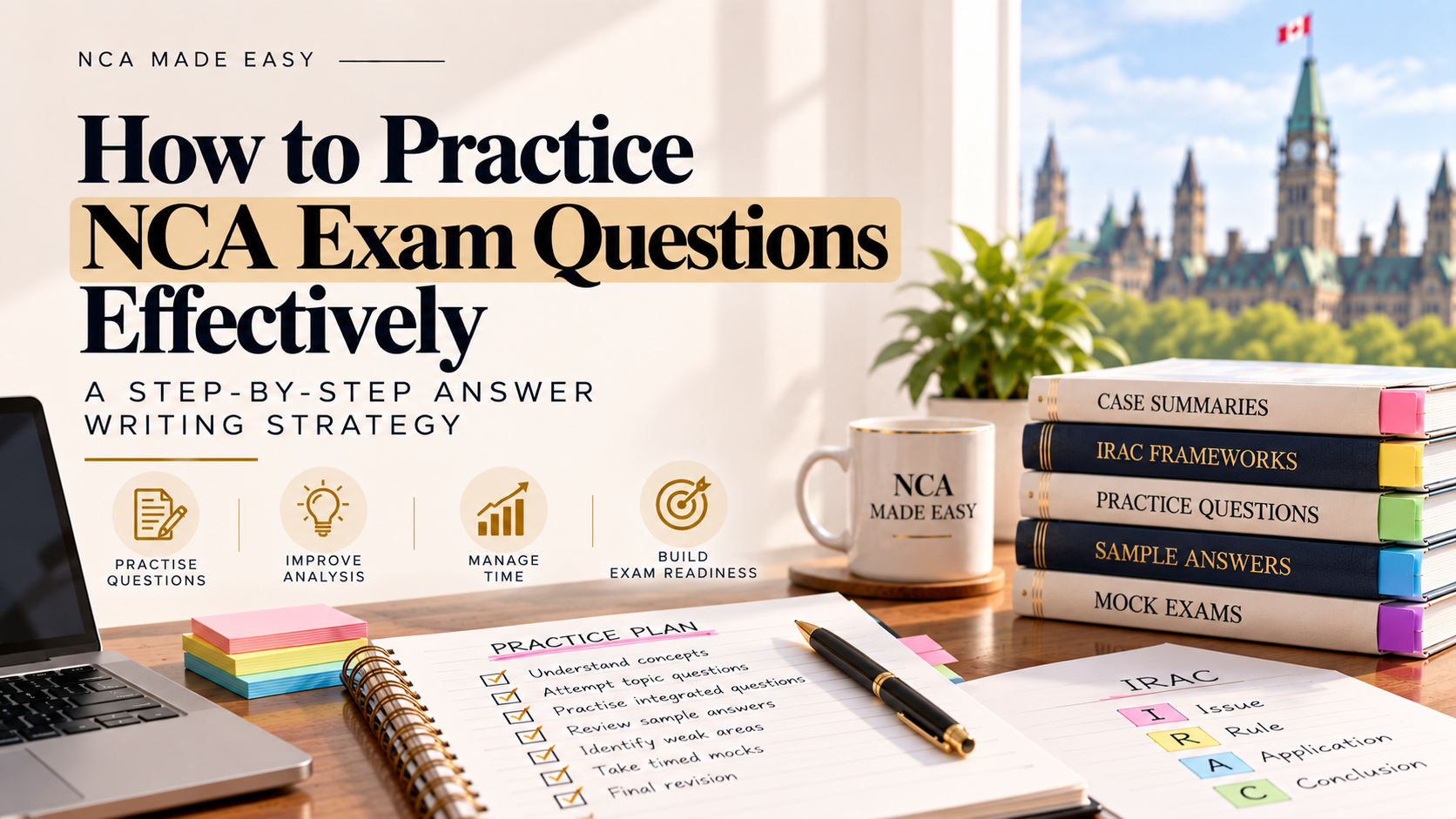
How to Practice NCA Exam Questions Effectively
Reading notes and understanding Canadian law are important parts of NCA exam preparation, but they are only part of the process. You also need to be able to identify legal issues from a fact pattern, locate the relevant law quickly, apply that law to the facts, and produce a clear answer within the available time.
This is why NCA answer writing practice should form a regular part of your preparation, rather than being left until the final few days before the exam.
A structured approach to practice can help you identify weaknesses early and gradually improve both the quality and speed of your answers.
1. Build Your Concepts Before Starting Full Answers
Before attempting lengthy fact-pattern questions, make sure you understand the major concepts in the syllabus.
For each topic, you should be able to identify:
* the relevant legal issue;
* the governing rule or test;
* important statutory provisions;
* relevant cases or authorities;
* the elements that need to be established; and
* how those principles are applied to facts.
You do not need to wait until you have completed the entire syllabus before practising. Once you finish a chapter or major topic, you can begin attempting questions relating to that area.
This creates a useful cycle:
Learn → Review → Practise → Identify Weaknesses → Revise → Practise Again
2. Start With Topic-Based NCA Practice Questions
During the initial stage of preparation, start with questions dealing with individual topics.
For example, after studying a particular doctrine, attempt a question that requires you to recognise and apply that doctrine.
At this stage, the objective is not necessarily speed. Concentrate on whether you can:
* identify the correct issues;
* state the applicable law accurately;
* select relevant authorities;
* apply the law to the particular facts; and
* reach a reasoned conclusion.
Once this becomes comfortable, move to more complex questions.
3. Progress to Integrated Fact-Pattern Questions
NCA questions may require candidates to deal with several issues within the same factual scenario.
This makes integrated question practice particularly useful.
Instead of assuming that a question concerns only one chapter, read the entire fact pattern and ask:
What legal issues are actually raised by these facts?
Prepare a short issue list before writing.
For example:
Issue 1 → Rule → Application → Conclusion
Issue 2 → Rule → Application → Conclusion
Issue 3 → Rule → Application → Conclusion
This helps prevent an answer from becoming one long discussion in which different legal issues are mixed together.
4. Use IRAC as a Framework, Not a Script
IRAC can provide a useful structure for NCA answers:
I – Issue
Identify the legal question raised by the facts.
R – Rule
State the relevant legal principles, legislation and authorities.
A – Application
Apply those principles specifically to the facts given in the question.
C – Conclusion
Provide a reasoned conclusion based on the analysis.
However, IRAC should not turn your answer into a mechanical reproduction of memorised notes.
The application is particularly important because this is where you demonstrate that you understand how the law operates on the facts before you.
5. Avoid Writing a Purely Theoretical Answer
A common problem in legal exams is spending too much time explaining the law without sufficiently applying it.
Knowing a legal test is different from applying that test.
After stating a rule, ask yourself:
Which fact in the question makes this rule relevant?
Then connect the two directly.
Where the facts reasonably permit different arguments, consider both sides before reaching your conclusion. This produces a more analytical answer than simply stating what you believe the outcome should be.
6. Practise Finding Authorities Quickly
During practice, do not focus only on writing.
Also practise locating information efficiently within the materials you intend to use for preparation.
You should know where to find:
* important cases;
* statutory provisions;
* legal tests;
* exceptions;
* IRAC frameworks; and
* frequently tested principles.
A good set of notes is useful only if you can find the relevant information efficiently when working through a question.
Consider using headings, tabs, highlighting and a simple index so that important topics are easy to locate.
7. Practise According to the Marks Available
The marks assigned to a question should influence the depth and time given to the answer.
A short question should not receive the same amount of time as a major fact-pattern question.
When practising, note the marks beside each question and ask:
* How many issues are likely involved?
* How much detail is appropriate?
* How long should I reasonably spend on this answer?
This helps develop proportionality in exam writing.
8. Gradually Introduce Timed Answer Writing
Your first few practice answers do not necessarily need to be completed under strict timed conditions.
Initially, focus on producing a legally sound and well-structured answer.
Once your structure improves, introduce time limits.
A useful progression is:
Stage 1: Open practice without a strict time limit
Stage 2: Individual questions under time limits
Stage 3: Multiple questions consecutively
Stage 4: Full mock examination under timed conditions
This is generally more effective than attempting full timed mocks before developing a reliable answer-writing method.
9. Review Every Practice Answer
Writing an answer is only half of the exercise.
After completing it, compare your work against a detailed sample answer or feedback and identify what was missing.
Review:
* issues you failed to identify;
* rules or authorities you omitted;
* unnecessary theory;
* weak factual application;
* unclear organisation;
* unsupported conclusions; and
* time-management problems.
Keep a short list of recurring mistakes. If the same problem appears repeatedly, make it a specific target for your next practice session.
10. Use Mock Exams During the Final Stage
Once you have covered the syllabus and completed sufficient question practice, begin writing full mock exams.
Ideally, your final preparation should include at least 2–3 properly timed mock exams where possible.
A mock is most useful when it replicates exam conditions as closely as practicable.
Afterwards, do not look only at the overall performance. Determine:
Did I identify all major issues?
Was my application detailed enough?
Did I spend too long on one question?
Were my conclusions supported by analysis?
Could I locate the required law efficiently?
Use the answers to these questions to guide your final revision.
How NCA MADE EASY Helps With Answer Writing
At NCA MADE EASY, preparation is designed to go beyond simply providing lecture recordings or notes.
Depending on the subject package, students receive resources such as:
* comprehensive lecture recordings;
* updated subject notes;
* IRAC frameworks;
* chapter-wise and integrated practice questions;
* detailed sample answers;
* sample NCA exam answer scripts;
* answer-writing guidance;
* practice answer review and feedback;
* mock examinations and evaluation; and
* doubt clearing throughout preparation.
Students can therefore work through the syllabus while simultaneously developing the ability to apply what they have learned in exam-style questions.
Final Preparation Tip
Do not measure NCA preparation only by how many hours you have studied or how many pages you have read.
A better question is:
Can I take an unfamiliar fact pattern, identify the relevant issues, find the applicable law, apply it properly, and produce a structured answer within the available time?
If the answer is not yet yes, continue practising.
Strong NCA preparation combines conceptual understanding, organised materials, repeated answer-writing practice, feedback and timed mock exams.
For NCA preparation resources, subject packages and guidance:
Website: www.ncamadeeasy.com
YouTube: @ncamadeeasy
WhatsApp: +91 8123283217
Candidates should always refer to the current official NCA syllabus, policies and examination information when planning their preparation.