 27 September, 2026
 Vidya
VidyaHow to Organize Your NCA Exam Notes for Faster and Better Answer Writing
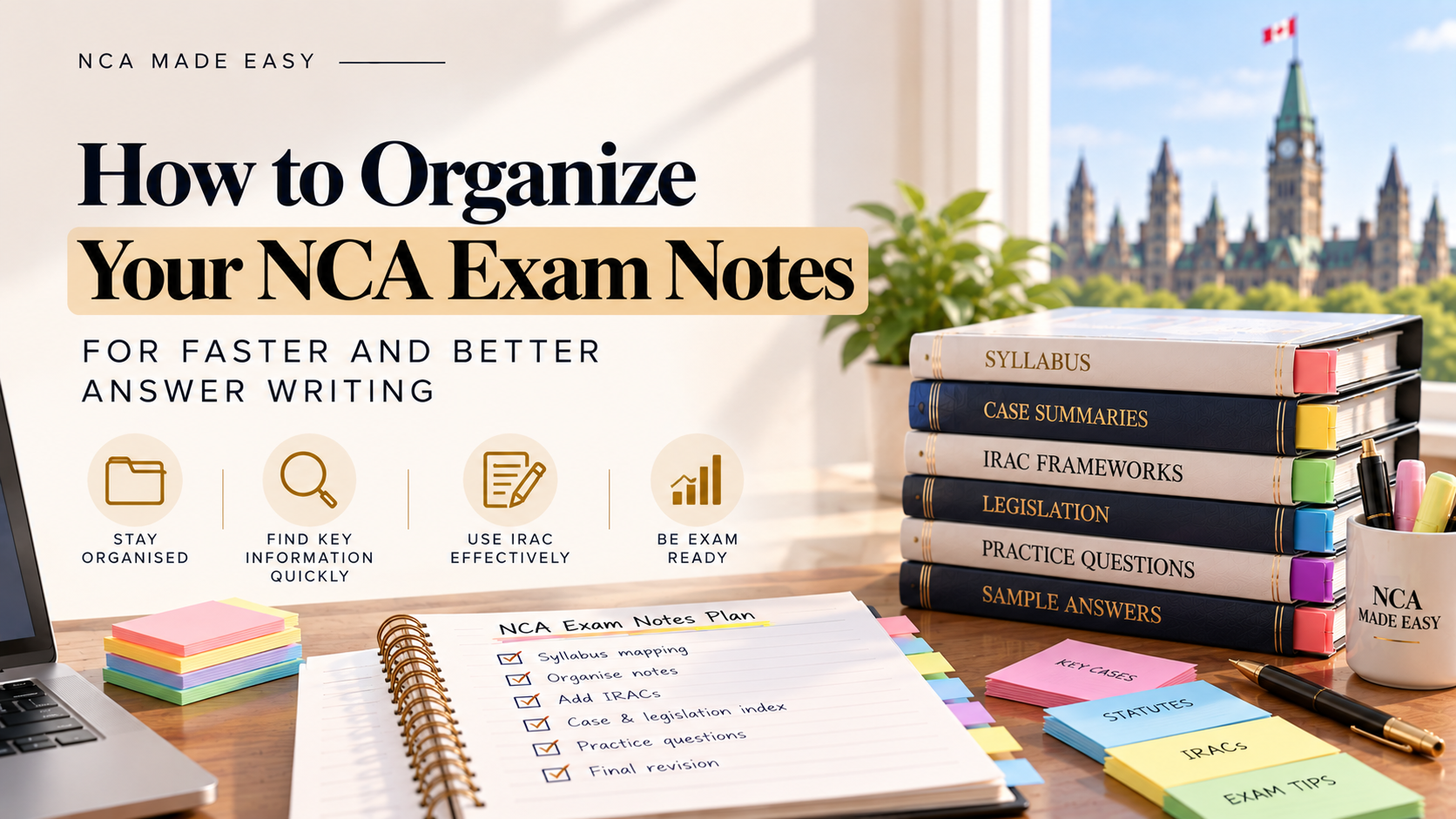
How to Organize Your NCA Exam Notes for Faster and Better Answer Writing
One of the biggest mistakes NCA candidates can make is assuming that having comprehensive study materials automatically means they will be able to use those materials effectively during an exam.
You may have detailed notes, case summaries, legislation, IRAC frameworks and practice answers. But if you cannot quickly identify what you need when faced with a fact-pattern question, those materials may not help as much as expected.
Effective NCA exam preparation therefore involves two separate skills:
Knowing the law and knowing where to find the law.
Your study materials should be organised to support fast issue spotting, accurate legal analysis and efficient answer writing.
1. Your Notes Should Follow the NCA Syllabus
The current NCA syllabus should form the foundation of your preparation.
Instead of organising your notes randomly by cases or readings, structure them according to the major topics and subtopics appearing in the syllabus.
This creates a logical connection between:
Syllabus → Topic → Legal Issue → Rule → Authority → Application
When you encounter an issue in a practice question, you should know approximately where that topic appears in your materials.
This becomes increasingly important as your notes become longer.
2. Use Clear Headings and Subheadings
Long blocks of text are difficult to navigate quickly.
Each major topic should have a clear heading, followed by logical subheadings.
For example, rather than having one lengthy section called “Judicial Review,” Administrative Law materials may separate the relevant concepts into distinct headings and analytical stages.
The objective is simple: when you recognise an issue, you should be able to reach the relevant section without reading several pages first.
Consistent formatting also helps your brain remember where information is located.
3. Create a Detailed Table of Contents
A good table of contents can become one of the most useful parts of your NCA materials.
It should allow you to locate important topics quickly.
Depending on the subject, your table of contents may include:
* major syllabus topics;
* legal tests;
* important doctrines;
* statutory provisions;
* remedies;
* constitutional or Charter provisions;
* frequently tested issues; and
* other important analytical frameworks.
Do not wait until the day before the examination to learn how your table of contents works.
Use it throughout your preparation so navigating the materials becomes familiar.
4. Separate Legal Rules From Detailed Explanation
Your comprehensive notes may contain detailed explanations because you need them while learning the subject.
But during answer writing, you often need something more concise.
For each major issue, you should be able to identify quickly:
What is the applicable legal test?
Which authority supports it?
Are there relevant statutory provisions?
What factors must be considered?
What comes next in the analysis?
This is one reason IRAC frameworks can be useful alongside comprehensive notes.
The notes help you learn the law.
The IRACs help you apply the law.
5. Keep Your IRAC Frameworks Easy to Access
An IRAC framework should not simply repeat pages of theory.
Its purpose is to help you structure an exam answer.
A useful framework should remind you of:
* the issue;
* the essential legal rules;
* relevant authorities;
* the order of analysis;
* factual questions that should be considered; and
* how to move toward a conclusion.
The Application section is particularly important.
Rather than providing a pre-written answer, a good IRAC should leave room for you to insert and analyse the facts given in the examination.
That makes the framework adaptable to unfamiliar fact patterns.
6. Know Your Important Authorities
Candidates sometimes create enormous lists of cases without understanding how those cases fit into the legal analysis.
A better approach is to know why an authority matters.
For each important case, ask:
What proposition does this case support?
At what stage of the analysis would I use it?
Is it establishing a legal test, illustrating its application, or modifying an existing principle?
Knowing the role of the authority makes it much easier to use cases purposefully in an answer.
Your notes should make those relationships clear.
7. Organize Statutory Provisions Alongside the Relevant Topics
Where legislation is important, avoid treating statutory provisions as completely separate from the substantive topic.
If a particular section is relevant to an issue, make that connection clear in your materials.
This reduces the amount of searching required when answering a question.
You should know:
which provision applies, what it does, and when you need to use it.
The same principle applies to constitutional provisions, regulations and other prescribed legal authorities.
8. Use Your Practice Questions to Improve Your Notes
Practice questions are not only useful for improving answer writing.
They can also reveal weaknesses in your study materials.
While answering a question, ask yourself:
* Was the relevant legal rule easy to locate?
* Did my notes clearly identify the applicable authority?
* Was the analytical sequence obvious?
* Did I have enough information to apply the test?
* Did I waste time searching for something?
* Was an important issue missing from my quick-reference materials?
If you repeatedly struggle to find the same type of information, improve the organisation of your notes before the exam.
Your materials should evolve as you practise.
9. Do Not Overload Your Exam Materials
More material does not necessarily mean better preparation.
Candidates sometimes collect:
* multiple sets of notes;
* textbooks;
* old summaries;
* online materials;
* dozens of case briefs;
* several versions of the same legal test; and
* large quantities of material they have barely reviewed.
This can make navigation slower rather than faster.
The most useful materials are generally the ones you have actually studied and practised with.
You should understand how your resources are organised and know which document to consult for a particular purpose.
10. Use Different Resources for Different Purposes
Your materials do not all perform the same function.
A well-structured preparation package may contain several resources because each supports a different stage of preparation.
Comprehensive Notes
Used to understand the syllabus and substantive legal concepts.
Lecture Recordings
Used to understand difficult topics, legal frameworks and how concepts fit together.
IRAC Frameworks
Used to organise legal analysis and structure answers efficiently.
Questions and Answers
Used to practise applying legal rules to different fact patterns.
Sample Exam Answer Scripts
Used to understand the expected structure and depth of an exam response.
Mock Exams
Used to test whether you can bring everything together under timed conditions.
Using each resource for its intended purpose makes preparation considerably more systematic.
11. Practise Finding Information Under Time Pressure
Knowing that information exists somewhere in your notes is not enough.
You need to be able to locate it quickly.
During timed practice, notice how long you spend searching.
If you recognise the issue immediately but spend several minutes finding the relevant rule, that is a navigation problem.
Consider improving:
* headings;
* bookmarks;
* page references;
* your table of contents;
* document naming;
* indexing; and
* the placement of important IRAC frameworks.
Mock exams are particularly useful for identifying these problems.
12. Do Not Copy Your Notes Into the Answer
Well-organised notes make information easier to find, but they should not encourage you to reproduce large sections of theory.
An exam answer must respond to the question actually asked.
After locating the relevant rule, return to the facts.
Ask:
Why does this rule matter here?
Which fact triggers it?
How does the rule operate on that fact?
What argument can each side make?
What conclusion follows?
Your notes provide the legal tools.
Your answer must perform the legal analysis.
13. Make Your Materials Familiar Before Exam Day
Do not reorganise everything immediately before your examination unless there is a genuine problem.
By the final stage of preparation, your materials should feel familiar.
You should know approximately:
* where each major topic appears;
* where your IRAC frameworks are;
* how authorities are organised;
* where important statutory provisions can be found; and
* which resource to consult when you encounter a particular issue.
Familiarity saves time.
This is why candidates should use the same materials during practice questions and mock exams that they intend to rely on during their preparation for the actual examination.
How NCA MADE EASY Structures Exam Preparation Materials
At NCA MADE EASY, our complete subject packages are designed so that students do not have to rely on one large set of notes alone.
Depending on the subject package, students receive:
* comprehensive recorded lectures;
* notes updated according to the latest syllabus;
* IRAC frameworks covering the syllabus;
* Questions & Answers with detailed sample answers;
* sample NCA exam answer scripts;
* answer-writing guidance;
* practice questions for submission and review;
* doubt-clearing support;
* mock examinations; and
* mock evaluation with feedback and sample answers.
Students first use the lectures and notes to understand the concepts.
They then use IRAC frameworks and Questions & Answers to learn how those concepts operate in exam-style problems.
Practice answers are reviewed so that weaknesses in structure, legal rules and factual application can be corrected.
Finally, timed mock examinations help students test both their knowledge and their ability to use their materials efficiently.
Final Takeaway
Good NCA exam materials should do more than contain information.
They should help you move quickly through the analytical process:
Identify the issue → Find the rule → Locate the authority → Apply the facts → Reach a conclusion
The goal is not to create the biggest collection of notes.
The goal is to create a preparation system you understand and can use efficiently.
By the time you reach your examination, you should not be discovering your materials.
You should already know them.
For NCA exam preparation courses, updated study materials, IRAC frameworks, practice Questions & Answers and mock exam support, visit:
www.ncamadeeasy.com
Free NCA lectures:
www.youtube.com/@ncamadeeasy
For guidance regarding your NCA preparation, exam order or study strategy, contact NCA MADE EASY directly through WhatsApp.