 21 July, 2026
 Vidya
VidyaHow to Create an Effective NCA Study Plan (Without Feeling Overwhelmed)
How to Create an Effective NCA Study Plan (Without Feeling Overwhelmed)
One of the first questions many NCA candidates ask is:
“Where do I even begin?”
With lengthy reading lists, case law, legislation, and multiple subjects to prepare for, it’s easy to feel overwhelmed before you even start.
The good news is that successful candidates don’t necessarily study more than everyone else—they study more strategically.
A well-planned study schedule helps you stay consistent, avoid burnout, and prepare with confidence.
⸻
Why Most Study Plans Fail
Many candidates make one of these mistakes:
* Studying only when they “feel motivated”
* Spending too much time on favourite topics
* Ignoring difficult chapters until the last minute
* Reading continuously without revision
* Leaving answer writing until the week before the exam
Without structure, preparation quickly becomes stressful.
⸻
Step 1: Start With Your Exam Date
Before opening a textbook or watching a lecture, calculate exactly how many days remain before your exam.
Then divide your preparation into clear stages.
Avoid thinking:
“I have three months.”
Instead think:
“I have 90 study days.”
This makes planning much more realistic.
⸻
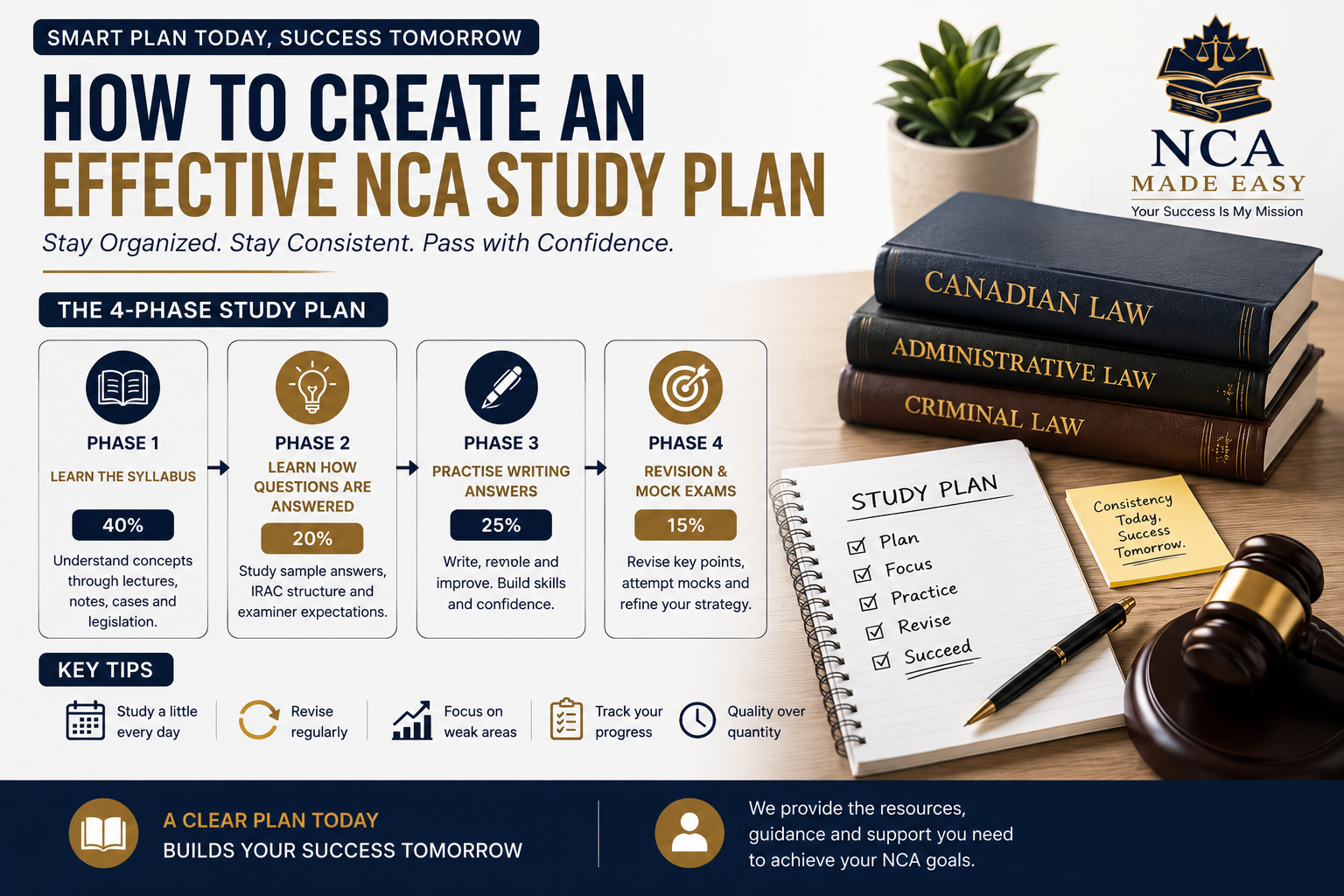
Step 2: Divide Your Preparation Into Four Phases
An effective NCA study plan should include all four phases—not just reading.
Phase 1 – Learn the Syllabus (40%)
Focus on understanding the subject.
This includes:
* watching lectures
* reading study notes
* reviewing legislation
* understanding leading cases
At this stage, don’t worry about memorising everything.
Your goal is to understand the concepts.
⸻
Phase 2 – Learn How Questions Are Answered (20%)
Many candidates skip this step.
Spend time reviewing:
* sample answers
* IRAC structure
* examiner expectations
* previous-style questions
Understanding how answers are structured is just as important as understanding the law.
⸻
Phase 3 – Practise Writing Answers (25%)
Knowledge alone doesn’t pass NCA exams.
You need to practise applying the law.
Write answers regularly.
Review them.
Identify weaknesses.
Improve.
Repeat.
This stage builds confidence before the actual exam.
⸻
Phase 4 – Revision and Mock Exams (15%)
The final stage should focus on:
* revising legal tests
* reviewing important cases
* timed mock exams
* improving time management
* correcting recurring mistakes
By this stage, you should already know the syllabus.
Now you’re refining your performance.
⸻
Study a Little Every Day
Consistency beats intensity.
Studying for two focused hours every day is generally more productive than studying for ten hours once a week.
Daily study helps retain information and reduces stress.
⸻
Build Revision Into Your Schedule
Revision shouldn’t happen only before the exam.
Instead:
* revise at the end of each week
* revisit difficult topics regularly
* keep updating your summaries
The more frequently you revisit a topic, the easier it becomes to remember.
⸻
Don’t Ignore Weak Areas
Every candidate has chapters they enjoy and chapters they avoid.
The difficult chapters are usually the ones that deserve the most attention.
Identify them early.
Spend additional time understanding them.
Don’t leave them until the last week.
⸻
Track Your Progress
A simple checklist can keep you motivated.
For each chapter, track:
✅ Lecture completed
✅ Notes reviewed
✅ Cases understood
✅ Practice question completed
✅ Revision completed
Seeing your progress makes preparation feel much more manageable.
⸻
Remember That Quality Matters More Than Quantity
Studying twelve hours a day doesn’t automatically lead to better results.
Effective preparation is about:
* understanding concepts
* applying legal principles
* practising consistently
* revising regularly
A focused, structured study session is often far more valuable than hours of passive reading.
⸻
Final Thoughts
Every successful NCA candidate has one thing in common:
They follow a plan.
A structured study schedule reduces stress, improves consistency, and helps you cover the syllabus with confidence.
Instead of asking,
“How much should I study today?”
Ask,
“What is today’s goal?”
Small, consistent progress over several weeks leads to better exam performance than last-minute cramming.
⸻
How NCA MADE EASY Supports Your Preparation
At NCA MADE EASY, every student receives more than just study materials.
Our preparation includes:
* Comprehensive recorded lectures
* Updated study materials
* Structured notes
* IRACs and exam-focused Q&As
* Personalised study plans based on your exam date
* Answer-writing guidance
* Practice questions
* Mock exam support
* Ongoing doubt clarification
A clear plan, combined with the right resources and consistent practice, can make your NCA journey significantly more manageable.