 21 July, 2026
 Vidya
Vidya7 Mistakes That Cause NCA Candidates to Fail (And How to Avoid Them)
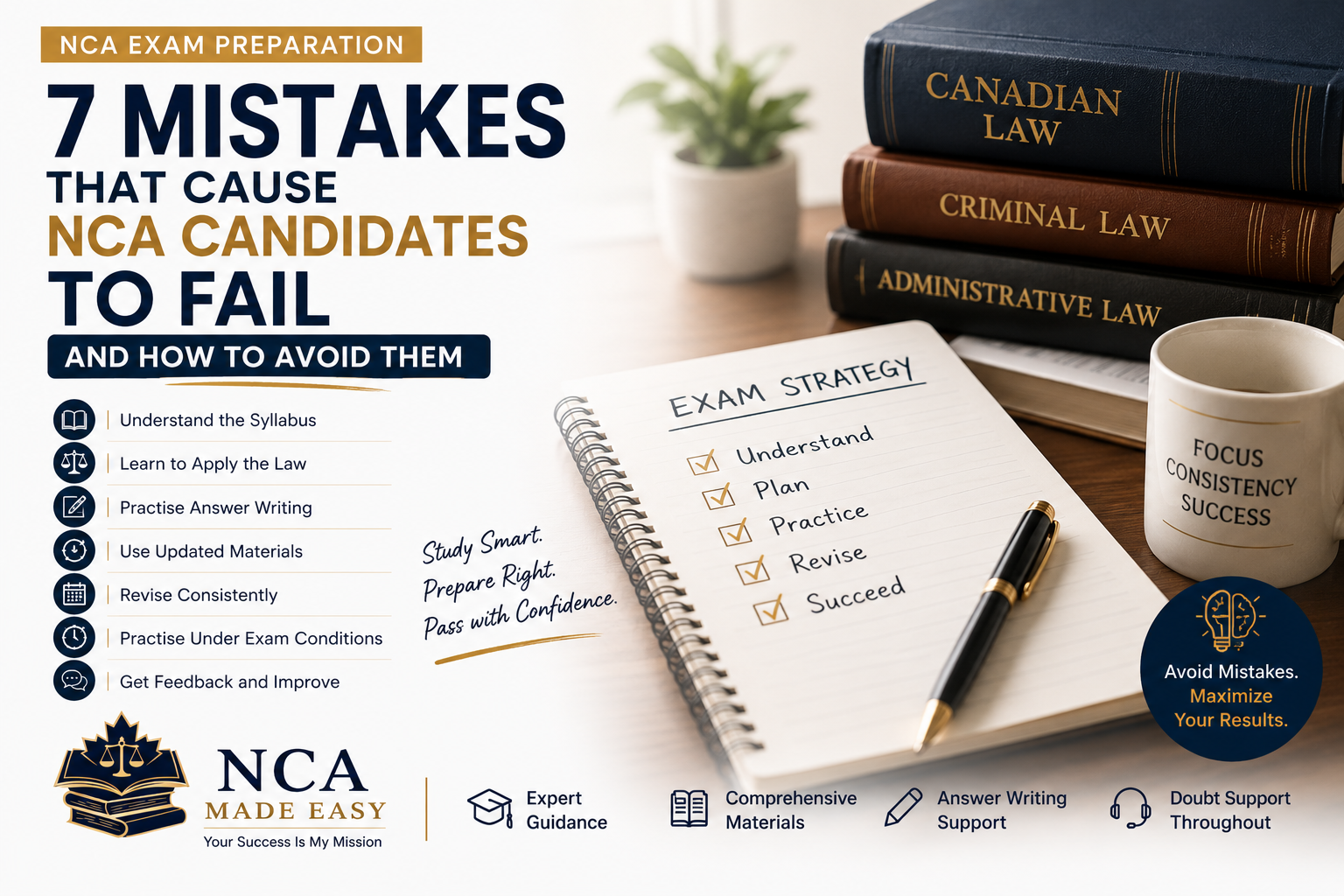
7 Mistakes That Cause NCA Candidates to Fail (And How to Avoid Them)
Every NCA candidate begins their preparation with the same goal—to pass the exams and move one step closer to practising law in Canada.
However, many candidates discover that simply reading notes or spending long hours studying does not always translate into success.
Having mentored numerous foreign-trained lawyers through their NCA journey, we’ve noticed several recurring mistakes that prevent otherwise capable candidates from performing well in the exam.
If you’re preparing for an upcoming NCA examination, avoiding these mistakes can significantly improve your preparation.
⸻
1. Starting Without Understanding the Official Syllabus
Many candidates begin watching lectures or reading notes before carefully reviewing the official NCA syllabus.
The syllabus tells you:
* what topics are examinable
* which cases are important
* recommended readings
* how the subject is structured
Understanding the syllabus first gives purpose to your study.
Tip: Print the syllabus and use it as your preparation checklist.
⸻
2. Reading Instead of Learning to Apply the Law
One of the biggest differences between law school and the NCA exams is application.
The exam does not reward memorization alone.
Instead, examiners expect candidates to:
* identify legal issues
* apply legal principles
* discuss relevant cases
* reach a logical conclusion
Reading the same notes repeatedly rarely develops these skills.
⸻
3. Ignoring Answer Writing Practice
Many candidates complete the entire syllabus without writing a single practice answer.
This often leads to:
* poor issue spotting
* weak legal analysis
* incomplete answers
* running out of time during the exam
The only way to improve legal writing is through consistent practice.
⸻
4. Studying Outdated Materials
The NCA regularly updates its syllabus.
New Supreme Court of Canada decisions and legislative developments may become examinable while older materials become outdated.
Candidates relying on old notes may unknowingly miss important developments.
Always ensure your materials reflect the current syllabus.
⸻
5. Leaving Revision Until the Final Week
Many students spend weeks covering new topics and only begin revision a few days before the exam.
By then:
* important cases are forgotten
* legal tests become unclear
* confidence decreases
A better approach is to revise throughout your preparation rather than only at the end.
⸻
6. Not Practising Under Exam Conditions
The NCA examinations require candidates to manage time effectively.
Many students know the law but struggle because they have never attempted a full three-hour exam before.
Completing timed mock examinations helps you:
* improve time management
* organize answers efficiently
* reduce exam-day anxiety
⸻
7. Studying Alone Without Feedback
One of the biggest challenges for self-study candidates is not knowing whether their answers meet the examiner’s expectations.
Without feedback, candidates often repeat the same mistakes throughout their preparation.
Constructive feedback helps improve:
* legal reasoning
* answer structure
* issue identification
* application of authorities
⸻
How to Prepare More Effectively
Successful NCA candidates generally follow a structured approach:
Step 1
Understand the official syllabus.
Step 2
Watch lectures or study notes chapter by chapter.
Step 3
Prepare summaries and revise regularly.
Step 4
Practise IRAC and problem questions.
Step 5
Write complete answers under timed conditions.
Step 6
Review mistakes and improve before attempting the next practice question.
This systematic approach builds confidence and improves exam performance.
⸻
Final Thoughts
Passing the NCA exams is not about studying the longest.
It is about studying strategically.
Avoiding these common mistakes can save months of frustration and significantly improve your chances of success.
Every candidate’s journey is different, but one thing remains constant—consistent practice, structured preparation, and regular revision produce better results than last-minute cramming.
If you’re preparing for an upcoming Professional Responsibility, Criminal Law, Administrative Law, Contracts, Constitutional Law, Property Law, or Foundations of Canadian Law exam, make sure your preparation is aligned with the latest syllabus and focuses not only on learning the law but also on applying it effectively.
⸻
Need Guidance?
At NCA MADE EASY, we help foreign-trained lawyers prepare for the NCA exams with:
* Updated study materials
* Comprehensive recorded lectures
* Exam-focused notes
* IRACs and practice questions
* Answer-writing guidance
* Mock exam evaluation
* Personal study plans
* Ongoing doubt support
Explore our courses or contact us if you’d like guidance on planning your NCA preparation.